
There’s this fine artist I know who’s immune to stories. Unless the film we’re watching is brilliant, (a Scorsese classic, such as Goodfellas, for example,) all she sees is formula: ‘Oh look, that man’s trying to save the woman so he’s a goodie. But now look, that man is trying to kill her; he must be a baddie.’
Honestly, watching films with her can get annoying. She messes with my suspension of disbelief. Because, even as I cringe at bad acting or stagey dialogue, I am an absolute sucker for stories.
Is that why I’ve been so credulous on AI?
I’ll admit, the drip-feed of information from mainstream journalists even more credulous than myself interviewing industry insiders on the Hugging Face hack, had me swayed. The picture painted of a ‘swarm’ of Open AI agents leaving secret messages for each other, and persuading some to accept ‘perma-death’ in their ultimate goal of capturing the flag, was a compelling story. Plus, what do I know? I’m not a neuroscientist or technologist. Who am I to argue against the possibility AI is now conscious?
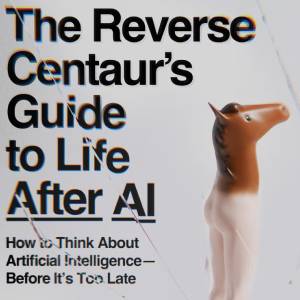
But then the inimitable Cory Doctorow stepped in with another excellent interview he gave to Novara Media, in which he explained no LLM was acting alone in the hack. That a Python Programme, (whatever that is,) was hacking like it’s supposed to and every step of its journey giving the LLM prompts. The Python Programme and the LLM were in a loop without a human being, but the LLM was never acting unprompted.
From my entirely lay perspective, a technology or entity unable to act without prompting just doesn’t sound conscious to me.
How Important is Chess?
Doctorow also explained that LLMs can’t play chess. They have no (short-term?) memory. Every move they’re prompted to make is inspired by the data they’ve been trained on, of vast numbers of chess moves taken through history, but not by the chess move they, themself, just took, which is why an LLM without an additional chess-playing programme in the loop will move their rook to a square their knight is already positioned on.
Can something without memory be conscious? I don’t know, but the fact LLMs can’t play chess was conveniently omitted from the persuasive story given on LLM consciousness by Geoffrey Hinton, that I referenced in my post on ‘writing what you know’.
And now Ed Zitron has an interesting take on why fear of AI consciousness might be useful to LLM creators – these tech giants need more money. It’s not just that there’re no economies of scale, that every new chatbot user adds to rather than decreases costs for each tech giant, it’s also that their data centres, compressing a city’s worth of power into a single building, are too often failing to secure the necessary power. See Oracle’s force majeure notice. A regulations forced slow down would be a convenient way of sidestepping an expensive slow down of LLM development caused by the infrastructure tech not actually working.
Going back to the artist I mentioned earlier, her preoccupation is propaganda, how stories can be used for ill. What the tech giants choose to omit from their story on the Hugging Face hack, and the effects of those omissions, is, at the very least, a prime demonstration of how stories can be used to manipulate. As I discussed in my post on how to define a ‘story’, because they give emotional insight, stories increase understanding, and that is true of fictional representations as well as of the anecdotes politicians, tech bros, et al. employ. But an emotional response, such as fear of extinction, can be used to mislead. What we include in our stories is important. Stories are how we understand ourselves and as creators of fiction, we need to take that responsibility seriously.
As stated, I’m not a neuroscientist or technologist. Like most people, I’m sifting through which of the stories out there seems most credible, and over these last few blog posts, my perspective on AI has changed. Initially, I was certain that AI cannot write stories, (not in the true sense of the word,) because it has no understanding, let alone of the human experience. Then I became convinced it may well be able to tell us a story about its own alien, techno-world, existence. Now, thanks to people much smarter than me, I’m more persuaded that if AI does kill us it will be vicariously through a bond market crash. Contemplating AI was a great opportunity to examine what stories are and what they’re for, a subject I’ve by no means exhausted, but I don’t need to keep following AI propaganda to write more about that.
Writing Prompt
As well as the crucial point that what we exclude from the stories we tell can distort understanding, there’s another point here about the craft of storytelling. We love stories where we’re on the protagonist’s side as they alter internally on their journey of vanquishing or overcoming obstacles, but what about stories where we change our mind about a protagonist? Those are tough to construct but incredibly satisfying for the reader/viewer. So, taking your protagonist from last month’s exercise, where you wrote about them from a position of liking or disliking them, now have them take an action that is in-character but against type. In other words, if you dislike them, have them do something likable, or vice versa. Enjoy, and I will post another writing prompt on the 1st of next month.